
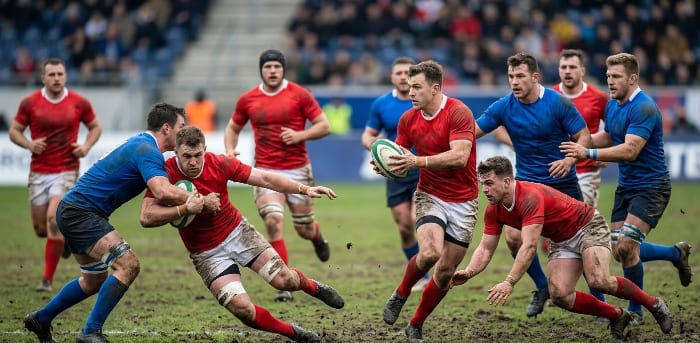
A helmet can fool the eye. It makes one sport look armored and the other look reckless, but the better answer is not that simple. American football vs rugby debates often turn loud because physical toughness looks different in each game. Football asks you to explode into violent, planned collisions, then reset for the next snap. Rugby asks you to absorb contact, get up, run again, tackle again, and think while your lungs are burning. For most American readers, the fairest answer is this: football demands the higher peak collision courage, while rugby demands the higher continuous contact endurance. That split matters because a linebacker and a flanker are not solving the same problem. One lives in bursts. The other lives in pressure. If you follow sports culture analysis or compare contact sports through a parent, fan, or athlete’s eyes, the real question is not which player is “tougher.” It is which kind of pain the sport teaches you to survive.
Why the Gear Changes the Kind of Contact
The pads and helmet in American football do more than protect players. They change how players move into danger. A safety closing on a receiver, a pulling guard smashing into a linebacker, or a running back meeting a goal-line tackle can all become full-speed collisions with little time to brace. Rugby has less hard equipment, so the tackle culture grew around wrapping, body position, and staying available after contact. The tension is plain: football gear lowers some visible harm while also allowing a style of impact that would be harder to attempt bareheaded. You can see the difference on a Friday night in Texas or Ohio, where a padded high school player may launch through a gap while a rugby tackler in a club match has to think about the landing as much as the hit.
Pads make football hits sharper, not softer
Football tackling carries a strange trade. The helmet and shoulder pads can make a player feel safer at the exact moment he is entering a dangerous space. That is why old coaching habits around “putting your head across” or “running through the target” have been under pressure for years. Modern coaching tries to move the head out of contact, but the sport still rewards sudden force. One false step can turn a clean stop into a knee collision, a shoulder injury, or a head snap that nobody sees from the stands.
You see it on a third-and-1 run in an NFL game. Everyone in the stadium knows where the ball is going. The defensive tackle fires low. The center and guard drive forward. A linebacker fills the gap. The collision happens in a phone booth, and it is not graceful. It is a short burst of power, mass, and nerve. The play may last less than ten seconds, yet the bodies inside it spend those seconds fighting for inches with no soft exit.
The non-obvious part is that pads can make toughness less visible. A football player may not bleed or limp after one play, but his body may have taken a heavy load through the neck, ribs, or knees. The uniform hides damage from the crowd. It does not erase it. That is why the cleanest-looking hit on television can still be the one a player feels when he gets out of bed the next morning.
Less padding makes rugby contact more honest
Rugby players do not get the same permission from equipment. A tackler who throws a shoulder with poor shape can hurt himself as much as the ball carrier. That creates a rough kind of self-policing. You learn to place the head, clamp the arms, and land in a way that lets you stand back up. A scrum cap may help with cuts and friction, but it is not armor. The body has to solve the tackle.
That does not make rugby gentle. It means the pain is often spread through repeat contact. A flanker may tackle, clear a ruck, carry into two defenders, and then sprint into the next defensive line inside a single minute. Rugby injuries often come from that pileup of fatigue, awkward contact, and bodies arriving from odd angles. The sport can punish a brave player who arrives half a step late as much as a timid one who avoids the job.
For American parents comparing youth contact sports safety, this matters more than the old “pads versus no pads” argument. Rugby can look scarier because players wear less. Football can look safer because players wear more. The harder truth is that each sport uses equipment to shape risk, not remove it. A safe program is not the one with the most gear. It is the one that teaches contact with care before the first match ever starts.
Where Physical Toughness Actually Shows Up
The scoreboard does not show the full cost of a collision sport. It tells you who gained yards, who won territory, and who scored. It does not show the moment a tight end has to block a defensive end again after getting folded on the last snap, or the moment a rugby center keeps defending after making three tackles in one passage. The deeper test is how a sport makes players recover before they feel ready. Training follows that demand. Football builds athletes for repeat explosions. Rugby builds athletes who can keep their shape while the game refuses to pause.
Football asks for violent precision in short windows
American football is built on repeated starts. That sounds easier until you understand what each start demands. A lineman may spend six seconds fighting another large athlete with hands, hips, feet, and angles. Then he has half a minute to breathe, listen, reset, and do it again. The body is not cruising. It is revving, stopping, and revving again.
Those pauses do not make the sport soft. They allow each snap to become more intense. Players can specialize their bodies for their jobs. An NFL nose tackle may carry a frame that would be hard to sustain in rugby. A wide receiver may train for speed, jumping, and survival over the middle. The sport turns athletes into tools for sharp tasks. That task focus is why a small slot receiver and a 320-pound guard can both be elite in the same offense.
That is why football can feel brutal despite its stop-start rhythm. A player knows the next collision is coming. He has time to think about it. Sometimes that waiting is worse than the hit. The whistle gives him breath, but it also gives him a countdown. He has to walk back into the same danger with the memory of the last one still fresh.
Rugby asks for contact while tired and exposed
Rugby is less friendly to specialization. A prop is not built like a winger, but everyone must tackle, carry, pass, chase, and make choices under fatigue. You cannot leave the field after one defensive stand and wait for your unit to return. You stay in the mess. Even the biggest forward has to make open-field decisions, and even the fastest back may need to clear out a ruck.
A good example is a long defensive sequence near the try line. The attacking team keeps carrying close. The defenders tackle, roll away, reload, and make another stop. By the tenth phase, the issue is no longer who enjoys contact. Nobody enjoys it then. The issue is who can keep safe technique while exhausted. A missed shoulder height, a lazy wrap, or a tired step inside can open the whole line.
That is where rugby earns its hard reputation. Contact while fresh is one skill. Contact when your legs feel empty is another. The second one punishes sloppy habits, and it exposes players who rely only on anger or size. Rugby also strips away the comfort of certainty. The ball can move after contact, and the next job may arrive from behind you, beside you, or at your feet.
Injury Risk Is Not a Simple Toughness Score
Injury data can help, but it should not be treated like a scoreboard for courage. Different rules, reporting systems, seasons, and player pools can change what the numbers mean. A college club rugby player and a scholarship football player may have different medical access, training support, and game schedules. Still, the broad warning is clear: both sports carry head, neck, shoulder, knee, and soft-tissue risks, and neither side gets to claim clean hands. Numbers are useful when they guide safer coaching. They become foolish when fans use them to crown one sport as the only hard one.
Head contact is the shared problem
The head is where the debate stops being fun. The CDC tracks sports-related traumatic brain injuries and concussions because head impacts are not minor trivia; they can affect school, work, mood, and long-term health. Anyone comparing football and rugby should spend time with the CDC’s sports-related TBI resources before pretending one sport has solved the issue. A concussion protocol is not a nuisance. It is a sign that the athlete’s future matters after the final whistle.
Football has spent years changing rules, adjusting kickoff structures, rating helmets, and testing helmet add-ons. Rugby has moved hard on high tackles, head-contact review, and tackle-height experiments. Those moves are not public relations decoration. They are signs that both sports know the old culture of “shake it off” was a bad bargain. The old language made players sound brave while hiding how little adults understood about recovery.
Here is the uncomfortable insight: safer rules can make a sport look less tough to old-school fans while making the athletes more skilled. A player who can hit hard without using the head is not weaker. He is better trained. The same is true for a referee who punishes high contact. That official is not softening the sport. He is forcing the sport to grow up.
The body breaks in different patterns
Football damage often follows the violence of the snap. Knees twist under piles. Ankles get trapped. Shoulders absorb hits at speed. Linemen take hand strikes and torque play after play. Skill players face open-field shots that can bend the body in directions it was not built to accept. Special teams can be rough because speed and space arrive together, which is why rule changes in that area always draw attention.
Rugby injuries often show up through accumulation. Rucks, scrums, tackles, mauls, and support runs layer strain onto the same body across a longer flow of play. A player may not suffer one highlight collision. Instead, he leaves with a swollen shoulder, bruised ribs, and legs that feel borrowed from someone else. The damage can feel ordinary because it arrives in pieces. That makes it easier to ignore.
This is why American football vs rugby arguments get stuck. The sports do not hurt people in the same rhythm. Football can be more explosive. Rugby can be more wearing. A fair comparison has to respect both. The better question is not which injury list scares you more. It is whether the athlete is being taught how to avoid needless damage while still playing hard.
The Mental Edge and Training Lessons for American Athletes
The body takes the hit, but the mind decides whether the player keeps playing well. That is where the comparison gets richer. Some athletes can handle one huge collision but lose focus when tired. Others can run and tackle all day but struggle with the fear of a planned impact against a bigger opponent. Toughness is not one trait. It is a set of habits under stress, and smart coaches in the United States can learn from both codes without pretending they are twins. The best lesson is simple: courage needs technique, or it becomes waste.
Football courage is knowing the collision is scheduled
Football is full of appointments with pain. A receiver running a slant knows a linebacker may be waiting. A running back in pass protection knows he may have to step into a blitzer with a running start. A cornerback knows one missed tackle can become a touchdown and a film-room embarrassment. The playbook gives order, but it also gives each player a place where the body may be tested.
That pressure is mental as much as physical. The huddle gives you time to imagine the hit. The play call tells you where you must go. Then the ball is snapped, and hesitation ruins everything. You cannot negotiate with the route, the gap, or the assignment. A tough football player is not fearless. He is trained enough to act before fear starts driving.
This is where football injury prevention training has to include more than strength work. Players need tackling form, neck strength, landing skills, and enough trust in the system to avoid panic. Rugby-style methods can help here because they teach head placement, shoulder contact, wrapping, and safer angles. A defender who keeps his head safer is not giving up force. He is making force repeatable. Better football tackling should feel controlled, not wild.
Rugby courage is making choices after pain
Rugby offers less time to reset emotionally. You may make a tackle, get stepped on, stand up, and have the ball passed toward you before your breath returns. The sport asks for judgment after discomfort. That is a rare demand. It is also why rugby can humble great gym athletes who have never had to make skill decisions while sore and winded.
The best rugby players do not look wild. They look calm in ugly spaces. A scrum-half digging the ball out near heavy boots, or a fullback fielding a high kick while defenders sprint toward him, has to choose fast without getting swallowed by the moment. Rugby injuries can rise when fatigue turns clear choices into desperate ones. Good teams train that moment instead of hoping bravery will cover it.
The counterintuitive truth is that rugby toughness often looks quiet. It is not always the biggest hit. Sometimes it is a tired player making the safe tackle, rolling away, getting back onside, and doing the next job without making a scene. Rugby can also learn from football’s power work, film habits, and recovery planning. The future belongs to trained toughness, not blind toughness. The athlete who lasts is not the one who ignores pain. It is the one who knows which pain is part of the job and which pain is a warning.
Conclusion
The fairest verdict is split. American football demands more peak collision force in shorter windows, especially at the line of scrimmage, in pass protection, and in open-field tackles. Rugby demands more repeated contact under fatigue, with fewer equipment buffers and more continuous decision-making. So the answer depends on what kind of hardship you respect most. A football player may face the scarier single snap. A rugby player may face the longer physical argument. That is why physical toughness is not a trophy one sport gets to keep forever. It changes shape with the rules, the pace, the gear, and the athlete’s job. For American fans, parents, and players, the wiser move is to stop using toughness as a brag and start using it as a question: how can contact sports teach courage without wasting bodies? Respect both games, study both, and judge the athlete by the demand he is trained to meet. The sport that wins the comparison may depend less on the rulebook than on the kind of pain you understand best.
Frequently Asked Questions
Is American football harder than rugby?
Football can be harder in short bursts because each snap allows players to explode into planned collisions. Rugby can be harder over time because players stay active through longer passages. The harder sport depends on whether you value peak force or repeated contact under fatigue.
Why do rugby players wear less padding than football players?
Rugby rules and tackling culture depend more on wrapping, body position, and staying available after contact. Heavy pads would change how players enter tackles. Less gear does not remove danger, but it does shape a different style of collision.
Are football hits more dangerous than rugby tackles?
Some football hits can involve higher-speed, sharper impacts, especially with blocking and open-field tackles. Rugby tackles can become dangerous through fatigue, poor height, and repeated contact. Neither sport is safe by default; coaching, rules, and player behavior make a large difference.
Which sport has more injuries, football or rugby?
It varies by level, age, reporting method, and medical access. Some college comparisons have found higher overall injury rates in rugby, while football carries major concern around head impacts and joint injuries. The better question is which risks apply to your age group and position.
Does wearing a helmet make football safer?
A helmet protects against skull injury and some impact forces, but it cannot remove concussion risk. It may also make players feel more willing to enter contact at high speed. Safe tackling and rule enforcement still matter as much as equipment.
Can rugby-style tackling help football players?
Yes, many coaches like rugby-style tackling because it teaches head placement, shoulder contact, wrapping, and safer angles. It does not fit every football situation, but it can help young defenders avoid using the helmet as the lead point.
Which sport requires more endurance?
Rugby usually requires more continuous endurance because players attack, defend, tackle, carry, and chase with fewer full stops. Football requires repeated power and recovery between snaps. One tests the gas tank; the other tests repeated explosion.
What should parents consider before choosing football or rugby for a child?
Look at coaching quality, medical support, concussion rules, practice contact limits, and how the program teaches tackling. A safer culture matters more than the sport’s reputation. Watch a practice before signing up, because the best clues appear there.