A champion’s body is not built at the table first; it is built before sunrise, in silence, on a packed clay ring. The Sumo Wrestling Diet matters because it supports a daily life most American sports fans never see: empty-stomach morning practice, repeated impact, strict stable hierarchy, large shared meals, and recovery that feels almost old-fashioned. A top-division rikishi is not chasing a beach-body version of fitness. He needs mass, balance, hip power, grip strength, pain tolerance, and the strange calm to explode in a bout that may last under ten seconds. That changes the whole logic of food and training. Chanko nabe, rice, naps, shiko, teppo, and sparring all work as one system, not separate habits. For readers used to NFL meal plans, powerlifting splits, or college wrestling cuts, sumo feels upside down. No breakfast. Huge lunch. Long rest. More food at night. Yet the best way to understand it is not as overeating. It is body construction for a sport with no weight classes at the highest level. That is why serious sports culture coverage keeps coming back to sumo: the routine looks simple from outside, then turns out to be brutally exact.
The Morning Ring Comes Before the Meal
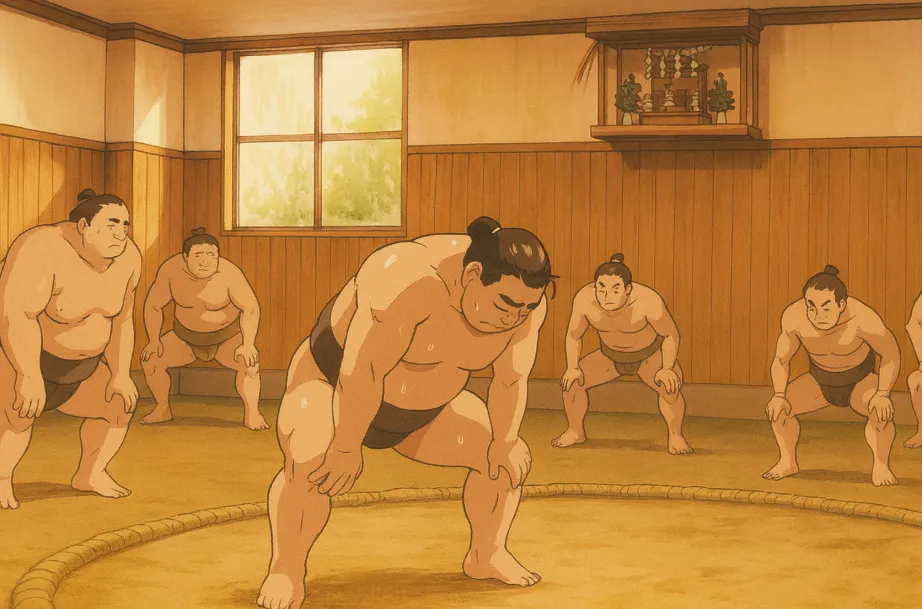
The day begins with work, not appetite. In a traditional stable, the lower-ranked wrestlers start first, often around dawn, while senior men enter later after the clay has already been warmed by sweat and footwork. Web Japan describes stable mornings beginning around 5:00 a.m., with lower-ranked rikishi training first and every stable having its own practice ring.
That order matters. It teaches the young wrestler that food is earned after effort. It also means a champion’s routine sits on a base of habits he learned when nobody was treating him like a star.
Why champions train hungry before eating big
To an American reader, training hard before breakfast may sound like bad planning. In sumo, it has a purpose. A full stomach does not help when bodies collide chest-first, heads snap, and a wrestler may be driven across the ring by another man near his own size.
The non-obvious part is that hunger is not treated as weakness. It becomes part of the rhythm. The morning session drains the body, sharpens aggression, and sets up the main meal as recovery rather than random intake. That is different from a bodybuilder eating every two hours or an NFL lineman sipping shakes between lifts.
A top-division champion has usually learned how far he can push that empty-stomach edge. Too little fuel the night before and practice feels flat. Too much late food and the morning turns heavy. The balance is personal, but the pattern is old: train first, eat after.
The old drills still decide modern power
The basic drills look plain until you try them. Shiko, the high leg raise and stomp, builds hips, balance, and patience. Teppo teaches the hands, feet, and hips to fire together against a wooden pole. Matawari opens the hips and groin so a large body can still move low and wide. Web Japan names shiko, teppo, and matawari as key exercises inside a wrestler’s daily practice.
A champion does not outgrow those drills. That is the lesson most gym culture misses. In the U.S., athletes often chase new equipment, new apps, and new metrics. Sumo keeps dragging the wrestler back to the same hard floor.
The ring punishes sloppy basics. If the hips rise too early, the wrestler gets moved. If the feet cross, he loses the line. If the hands hit without the legs, the charge dies. The diet adds size, but the drills teach that size where to go.
How the Sumo Wrestling Diet Builds More Than Size
The meal plan is famous because it looks huge. That part is true, but it is also the least interesting part. The better question is why the food is arranged around practice, rank, recovery, and stable life instead of personal preference.
Chanko nabe sits at the center because it can carry protein, vegetables, broth, tofu, fish, chicken, meatballs, mushrooms, greens, and whatever the stable cook has on hand. USA Sumo describes the traditional meal as a hotpot built from meats, vegetables, and broth, used after training to restore energy and support muscle repair.
Chanko nabe is not junk food in a bigger bowl
Many Americans hear “sumo meal” and picture greasy excess. That misses the point. Chanko nabe can be cleaner than plenty of high-calorie sports meals in the U.S. The issue is not that the dish is dirty. The issue is scale.
The stew gives the wrestler a base of warm liquid, salt, vegetables, and protein. Rice brings dense energy. Side dishes fill gaps. A young wrestler may eat past comfort because gaining mass can decide whether he survives against heavier opponents.
Here is the twist: the famous meal is less about one magic recipe and more about repeatable eating. A stable can feed many bodies from one pot. A wrestler can add rice, noodles, eggs, or extra meat without changing the whole kitchen. That flexibility is why chanko lasted.
The champion’s plate is built around work, not taste
A top-division champion does not eat like a tourist at a theme dinner. His plate has a job. It must refill glycogen after morning keiko, supply protein for damaged tissue, keep bodyweight high, and avoid foods that wreck the next day’s movement.
That does not mean the food is joyless. Stable meals have pride. Recipes travel through coaches, senior wrestlers, and former rikishi who open chanko restaurants after retirement. Still, the champion eats with the ring in mind.
The pattern also explains why “copy the diet” is bad advice for a normal gymgoer. Without hours of impact training, heavy squatting positions, and daily wrestling, the same intake becomes a health problem fast. The meal belongs to the workload.
Daily Training Is a Social System, Not a Workout Plan
A champion’s schedule is not a neat PDF with sets and reps. It is a living order inside the heya, the sumo stable. Rank shapes who trains first, who eats first, who serves, who cleans, and who gets corrected in front of everyone.
That social pressure is part of the training. You cannot separate the body from the room. A wrestler learns timing by being pushed around, but he also learns status, patience, and restraint by watching who speaks and who stays quiet.
Practice bouts create a pressure no machine can copy
After warmups and basics, the work turns more direct. Wrestlers collide, push, reset, and collide again. Butsukari-geiko can look harsh because one wrestler drives into another again and again while the receiver gives resistance.
This is where a champion becomes hard to move. Weight alone does not explain it. The feet have to slide without panic. The hips have to stay under the chest. The hands need to search for position while the lungs burn.
In an American football facility, coaches can build contact drills with bags and sleds. Sumo has its own version, but the human body remains the main tool. That is why practice carries a tension machines cannot give. The opponent thinks, resists, tricks, and punishes.
The stable clock teaches discipline without speeches
Some Tokyo stables allow visitors to observe morning practice when schedules permit. Arashio-beya, for example, lists morning keiko from 7:30 a.m. to 9:00 a.m. on its public visitor page, while warning that breaks and changes can happen.
That visitor window shows only a slice. The full day includes cleaning, bathing, eating, resting, chores, treatment, and sometimes public duties. For lower-ranked men, the chores can be as draining as the drills. For champions, obligations grow in a different direction: media, ceremonies, sponsors, and pressure to represent the sport.
The counterintuitive lesson is that routine protects the champion from fame. A wrestler who wins in the top division could become the center of national attention, yet the stable still pulls him back to the same ring, the same meal, and the same daily rhythm. Status rises. The clay stays hard.
Recovery, Weight, and Health Are the Hidden Battles
The public sees the size. The private battle is whether that size can be carried well. A top-division champion must be heavy enough to resist force, loose enough to change direction, and fresh enough to fight through a tournament schedule.
Grand sumo runs through repeated tournaments across the year, so the body rarely gets a clean off-season in the American sense. GQ’s profile of world champion Byambajav Ulambayar notes the year-round nature of training around six 15-day tournaments, which helps explain why eating and recovery stay constant rather than seasonal.
Naps are part of the plan, not laziness
After the main meal, sleep often follows. That can sound strange to readers raised on hustle culture, where rest has to be disguised as productivity. In sumo, the nap is blunt. Eat, recover, grow.
The timing makes sense. Morning practice breaks the body down. Lunch loads it back up. Rest gives the body a chance to adapt. A champion who skips recovery to look busy is not acting tough; he is stealing from the next session.
There is a health warning here too. Sumo size is sport-specific. For ordinary people, copying the nap-after-huge-meal cycle without the training load can add fat fast and stress the body. The lesson worth stealing is not the calorie count. It is the respect for recovery.
The best body is heavy, mobile, and calm
Top wrestlers do not all look the same. Some win with overwhelming mass. Some win with speed, throws, timing, or ring sense. The best bodies in sumo are not only large. They are usable.
That is why flexibility work matters. A stiff giant becomes easy to turn. A loose, low wrestler can absorb contact and redirect force. Watch a skilled rikishi survive at the edge of the tawara, the straw bales marking the ring, and you see balance under panic.
American strength athletes can learn from that. Size without positions is decoration. Strength without footwork leaks away. Food can build the frame, but practice teaches the frame how to fight.
Conclusion
Sumo asks a hard question that most modern fitness plans avoid: what should a body become when the sport, not the mirror, gets the final vote? The answer is not always pretty, and it is not meant for casual copying. A champion’s day is built from hunger, impact, repetition, shared meals, sleep, and rank pressure that never fully leaves the room. The Sumo Wrestling Diet works only because it is tied to that larger life. Pull it away from keiko, chanko duty, stable order, and tournament stress, and it becomes a cartoon version of itself. Keep the whole system together, and it starts to make sense. For American fans, the deeper lesson is not to eat like a rikishi. It is to match food to purpose, recovery to workload, and training to the actual demands of the sport. Read sumo that way, and the big meal stops being the headline. The discipline does. For more context on performance habits across sports, see athlete nutrition lessons for strength sports and traditional combat sports training culture.
Frequently Asked Questions
How many meals does a sumo wrestler eat in a day?
Many rikishi follow a two-meal pattern, with a large lunch after morning practice and another meal later in the day. The exact amount depends on rank, body size, stable habits, and training load. The timing matters as much as the food.
What is chanko nabe made of?
Chanko nabe is a hotpot that often includes broth, chicken, fish, tofu, meatballs, mushrooms, cabbage, greens, and other vegetables. Rice or noodles usually sit beside it. There is no single fixed recipe because each stable can make its own version.
Do sumo wrestlers train every morning?
Training usually happens in the morning, especially inside traditional stables, though schedules shift around tournaments, travel, injuries, and stable rules. Morning keiko can include basics, footwork, impact drills, and practice bouts before the first major meal.
Is a rikishi meal plan healthy for normal people?
For most people, no. The food quality may include protein and vegetables, but the portions are tied to extreme daily training and a sport that rewards mass. Without that workload, copying the intake can lead to fast weight gain and health strain.
Why do sumo wrestlers skip breakfast before practice?
A heavy meal before contact training can cause discomfort and slow movement. Empty-stomach practice also fits the stable rhythm: train hard first, then eat big as recovery. It is a sport-specific habit, not a general fitness rule.
What exercises do sumo wrestlers do daily?
Common basics include shiko for hips and balance, teppo for pushing mechanics, suriashi for sliding footwork, and matawari for flexibility. Practice bouts and collision drills build the contact skill that no weight machine can fully copy.
Can American athletes learn anything from sumo training?
Yes, but they should take principles, not copy the whole lifestyle. The best lessons are simple: repeat basics, build usable strength, recover on purpose, and eat for the demands of the sport instead of chasing a look.
How long does it take to build a sumo body?
Years. A top wrestler’s body comes from daily practice, stable living, high food intake, recovery, and constant technical work. Fast weight gain alone does not create a rikishi. The body has to learn balance, impact, timing, and control.